Introduction
The Gaza Strip has been the scene of one of the world’s most significant humanitarian crises since the turn of the 21st century, marked by intense conflicts and economic embargoes. The blockade, which has been expanded in scope by Israel in recent years, has profoundly altered the region’s socio-economic structure. The extensive closure of land, air and sea routes has effectively transformed Gaza into an open-air prison, isolated from the outside world and unable to sustain itself.
The situation has become critically precarious, particularly in terms of food security. UN agencies, international aid organizations, civil society groups and independent research have consistently revealed that most Gaza residents are experiencing food insecurity, a significant proportion of children suffer from chronic malnutrition, the health system is on the brink of collapse, and related deaths are occurring. This dire reality necessitates a re-evaluation of Israel’s responsibility within the framework of international law.
In this study, we will first assess the background of the food crisis caused by the Israeli blockade in Gaza. Subsequently, we will discuss how this situation should be interpreted under international law and analyze Israel’s responsibility stemming from this blockade. Finally, it will be argued that the food crisis in Gaza is not merely a regional issue but also a test of the international system’s core principles of justice, human rights, and the rule of law and the resulting responsibility incumbent upon the international community will be addressed.
The Background of the Food Crisis in Gaza
The food crisis currently unfolding in the Gaza Strip is a multi-layered phenomenon that requires a deep understanding considering both historical processes and current developments. The region has consistently been subjected to the influence of ongoing political conflicts, shifting regional power dynamics and international interventions since the middle of the 20th century. However, the fundamental causes of the present humanitarian crisis are directly attributable to the comprehensive blockade regime implemented by Israel following Hamas’s assumption of governance in the territory after 2007.
Following Hamas’s securing control in Gaza in 2007, the land, air, and sea borders were largely closed by both Israel and Egypt. This measure developed into a sweeping policy that almost completely isolated the region from the outside world. The blockade was not merely the physical closure of borders; it was implemented as a broad strategy aimed at systematically dismantling Gaza’s economic, social and humanitarian infrastructure. During this process, severe restrictions were imposed on the entry of vital products such as staple foods, medicines, agricultural equipment, and construction materials, and border controls were rigorously tightened. The consequences included increased income loss among families, barriers to children’s education, restricted access to healthcare, and widespread psychosocial trauma. Vulnerable groups, particularly women and children, have borne the heaviest economic and health burdens.
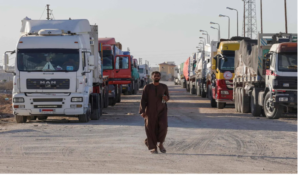
The intense Israel-Hamas hostilities that began on October 7, in the final quarter of 2023, dramatically exacerbated the food crisis in Gaza. During this period, Israeli military operations escalated, the blockade was critically tightened, and humanitarian aid efforts were more frequently obstructed. Significant restrictions and delays were imposed on the entry of foodstuffs into Gaza, leading to the rapid depletion of basic food stocks. Reports from the UN and international humanitarian aid organizations have indicated a surge in health issues stemming from chronic hunger and malnutrition, especially among children and infants. The infrastructure of health facilities has been severely compromised, and the accompanying water and energy crises have directly threatened food security. Humanitarian aid convoys were frequently blocked during this time, with the operations of some aid organizations being halted for military reasons or subjected to lengthy delays at border crossings. This situation has increased the region’s reliance on humanitarian aid while simultaneously accelerating the deepening of the humanitarian crises.
The consequences of the food crisis are not restricted to physical starvation; they have also taken a destructive toll on the psychological health of the community. The prolonged environment of hunger and insecurity has resulted in developmental disorders and trauma, particularly in children. The resilience of the social structure has diminished, and future expectations have been severely impacted. In summary, the food crisis in Gaza is a deep and multi-dimensional crisis that is a direct result of historical political conflicts and the long-standing blockade regime. The intense military operations and severe blockade conditions experienced between 2023 and 2025 have further magnified the humanitarian dimension of the crisis, making Gaza one of the most fragile and isolated territories in the world.
UN Reports and Data from International NGOs
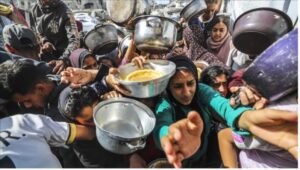
The United Nations (UN) and its subsidiary bodies regularly assess and report on the humanitarian situation in Gaza. In its 2024 report, the UN Office of the High Commissioner for Human Rights (OHCHR) stated that approximately 80% of the Gaza population is experiencing severe food insecurity. This rate is significantly high compared to similar conflict zones worldwide.[1] Crucially, the restriction on imports due to the blockade has caused food prices in Gaza’s markets to soar to astronomical levels, making access to staple foods virtually impossible for low-income families. The World Food Programme’s (WFP) 2024 report revealed that approximately 1.6 million people living in Gaza require regular humanitarian assistance. Food stocks have dropped to critically low levels, and during certain periods, basic foodstuffs have become severely scarce.
This situation is deepening the problems of hunger and malnutrition in the region. Furthermore, reports indicate that the lack of dietary diversity due to the blockade has restricted access to vitamin and mineral-rich foods, resulting in micronutrient deficiencies. Health-focused NGOs such as the International Committee of the Red Cross (ICRC) and Médecins Sans Frontières (MSF) state that the healthcare infrastructure is nearing the point of complete collapse due to the ongoing blockade and conflicts. Hospitals face shortages of medical supplies, medicine, and fuel and healthcare workers are under immense psychological and physical pressure. The frequent obstruction of humanitarian aid convoys caused by the blockade makes the timely delivery of essential supplies highly challenging.
The most devastating impact of the food crisis in Gaza is observed in children. According to UNICEF’s 2024 field research, 45% of children under the age of 5 are at risk of chronic malnutrition (stunting). This means these children are unable to complete their normal physical development, leading to long-term physical and mental disabilities. The UNICEF report further indicates that a significant proportion of child deaths in Gaza is directly linked to malnutrition. Moreover, children’s school attendance rates are declining due to hunger, their learning capabilities are weakening, and early entry into the workforce is increasing. This predicament threatens long-term development goals at both the individual and societal levels.
Assessment of the Israeli Blockade Under International Law
International Humanitarian Law (IHL) is recognized as the core body of norms that aims to protect the civilian population by defining the limits on measures that parties may employ during armed conflict. The Geneva Conventions adopted in 1949, and their 1977 Additional Protocols, constitute the cornerstones of International Humanitarian Law (IHL). Within this framework, measures applied in occupied territories and siege policies, such as blockades, are subject to specific legal rules. The blockade imposed on the Gaza Strip is primarily assessed under the provisions of the Fourth Geneva Convention concerning the protection of the civilian population.
Article 33 of the Fourth Geneva Convention prohibits all forms of punishment against civilians, stating, “No protected person may be punished for an offence he or she has not personally committed. Collective penalties and likewise all measures of intimidation or of terrorism are prohibited.” The meaning of this prohibition is that the punishment of a civilian population that has not committed individual crimes cannot be carried out by the occupying power or parties to the conflict. The prolonged and comprehensive nature of the blockade, which prevents the civilian population’s access to necessities, clearly contradicts this article.
Furthermore, Article 55 of the Geneva Conventions stipulates that the occupying power is responsible for ensuring the health and welfare of the population in the occupied territory. This mandates the uninterrupted provision of essential needs for the civilian population. The crisis in the supply of water, electricity, medical supplies and food due to the blockade in Gaza is considered a violation of this obligation. For example, the destructive effects of the blockade on health services were detailed in the 2023 reports of the UN Health Organization. The report emphasized that Gaza’s health system was at the point of collapse and that the scarcity of critical medicines and medical supplies was endangering the lives of patients.
The International Committee of the Red Cross (ICRC) report, “Customary International Humanitarian Law,” states that siege measures, such as blockades must be applied proportionately and discriminately to prevent harm to civilians; the principle of distinction requires parties to differentiate between the civilian population and military objectives, while the principle of proportionality mandates balancing the anticipated military advantage against the harm inflicted on civilians. However, the prolonged duration of the blockade in Gaza and the targeting of civilian infrastructure constitute a violation of the principles of distinction and proportionality. Considering these principles, the blockade has generated excessive and devastating consequences for the civilian population. International courts and human rights bodies focus on these two principles when examining blockade practices. In the International Court of Justice’s 2004 decision regarding the construction barrier imposed by Israel in Gaza, it was stated that obstructing the basic humanitarian needs of civilians is contrary to international law. Similarly, the ongoing International Criminal Court (ICC) investigation into the Gaza situation is discussing the blockade’s effects on civilians and the resulting legal responsibility.
Israel’s Responsibility Under International Law Regarding the Blockade of Gaza
The prolonged blockade imposed by Israel on the Gaza Strip raises a multi-layered discussion of responsibility within the context of international law. This situation is not merely limited to a state’s actions within its sovereign territory; it encompasses violations of the law of occupation, human rights law and international humanitarian law, thereby bringing up Israel’s direct and indirect responsibility. While international law is based on protecting the right to life of civilians and their access to necessities such as food and health, the blockade applied in Gaza has become a systematic practice that violates these fundamental principles. Within this framework, both Israel’s international legal responsibility as a state and the potential criminal responsibility of individual decision-makers must be addressed in detail.
Although Israel claims to have militarily withdrawn from Gaza in 2005, it is still considered the occupying power under international law due to its continued control over the borders, airspace and maritime routes. In this context, Israel’s obligation to ensure that the basic food and health needs of the population in Gaza are met continues, pursuant to Article 55 of the Fourth Geneva Convention. The fulfilment of these needs is rendered impossible due to the blockade, which means the occupying power is failing to meet its obligations. As explicitly stated in Article 33 of the Convention, “collective punishment” directed at the occupied civilian population is strictly prohibited.[2] The obstruction of vital necessities for civilians in Gaza constitutes a clear violation of the prohibition on collective punishment. The intensification of the blockade, especially following the military operations after 2023, indicates that civilians are being directly targeted and that the living conditions of the non-military population are being deliberately worsened. This involves actions that may constitute not only human rights violations but also war crimes or crimes against humanity.
Therefore, Israel’s responsibility under international law is multifaceted. On the one hand, in its capacity as the occupying power, it is violating its obligation to meet the basic needs of the people of Gaza; on the other hand, by targeting civilians through the blockade and military operations, it is committing serious human rights violations and potential war crimes. These practices by Israel are contrary to numerous international instruments, including the Fourth Geneva Convention, and give rise to legal responsibility both as a state and at the level of the relevant officials.[3] This blockade policy, which deliberately worsens the living conditions of the civilian population in Gaza, has long been recognized as falling under crimes against humanity within the scope of international criminal law.
Conclusion: The Gaza Blockade and Food Crisis as a Test of International Law, Human Rights, and Universal Justice
The food crisis unfolding in the Gaza Strip is not merely a regional humanitarian tragedy; it is also a serious test at the most sensitive points of international law, human rights and state responsibility. Israel’s blockade policy toward Gaza openly and systematically violates the international legal obligations it holds as an occupying power. The underlying reasons for these violations are not solely security concerns or political strategies; this crisis also reveals a complex scenario that challenges the conscience of the international community and the limits of the legal order.
The blockade imposed on Gaza has not only cut off humanitarian aid but has also evolved into a widespread humanitarian crisis by preventing access to health, education, clean water and basic foodstuffs. This situation constitutes a clear violation of the prohibition on “collective punishment”, strictly forbidden under Article 33 of the Fourth Geneva Convention. Israel’s policy challenges not only international legal norms but also the fundamental ethical and moral principles of the international community. The blockade directly and indirectly violates the fundamental human rights of the people of Gaza; millions of civilians, despite not being involved in the war or conflict, are being deprived of the right to life. In this context, the continuation of the blockade leads to serious discussions under the scope of crimes against humanity and necessitates action by the responsible authorities.
Ultimately, addressing the food crisis in Gaza from the perspective of international law and human rights provides a legal, ethical and political framework for fighting this crisis. Ending the blockade, prioritising the humanitarian needs of the people of Gaza and acting in accordance with the universal principles of international law are imperative not just for regional but for global peace and the establishment of justice. The common responsibility of the international community is to combine legal sanctions, diplomatic efforts and humanitarian aid to end this tragedy and prevent similar violations. Accordingly, ending the blockade policies and redressing the suffering of the people of Gaza is not only a humanitarian necessity but also the most powerful test of international law and universal conscience.
Footnotes:
[1] OHCHR, Report on the Situation in Gaza, 2024, p. 15-22.
[2] Muhammet Celal Kul, “Savaş Suçlarından Soykırıma: İsrail’in Gazze’deki Fiillerinin Hukuki Değerlendirmesi,” TAAD 16, NO.63 (Ankara, 2025): 385-390.
[3] TİHEK, Filistin’de İnsan Hakları İhlalleri ve Gazze Soykırım Raporu (Ankara, 2024), 84.
This article was first published on the Türkiye Research Foundation’s Turkish website on September 2, 2025.