Introduction
In recent years, the geopolitical rivalry among states in the Eastern Mediterranean has expanded into various domains and become increasingly competitive. In this process, the Israel–Greece axis, to which the Government of the Republic of Cyprus (GRC) has aligned itself, has gone beyond mere cooperation and has sought to reshape the region—primarily through disputes over maritime sovereignty and the division of marine resources. While focusing more intensely on security and energy issues, this axis—which seeks to consolidate power across various sectors in the region—can be said to be attempting to secure unjust advantages against countries in the Eastern Mediterranean, particularly Türkiye. In this sense, Greece and Israel which maintain their presence in the region through Western intervention are striving to form an anti-Türkiye axis and establish a military alliance rather than pursuing strategic-level cooperation.
The “anti-Türkiye” nature of this axis—which emerged with the inclusion of the Greek Cypriot Administration in the developing relations between Israel and Greece—has been emphasized in numerous studies on the subject. These relations, which began in the fields of tourism and energy, have evolved into a military alliance in recent years. Türkiye’s stance, which began with its withdrawal from Davos and the Mavi Marmara initiative and has become increasingly clear in parallel with the oppression in Palestine, has prompted Israel to seek a new alliance. Israel, which has embarked on a search for regional alliances, has established an influence extending from the Middle East to Europe through the relations it has developed with Greece since 2010. Due to Türkiye’s stance against violations in Palestine, Israel has turned to Greece—another country in the Aegean—and the Greek Cypriot administration (GCY), a state affiliated with it. Beyond projects in the natural gas and electricity sectors, Israel has expanded cooperation in the fields of technology and tourism.
The Background of the Israel-Greece Axis
It appears that the Tel Aviv administration is attempting to establish a new alliance network, particularly in the wake of the “endless war” it has launched in the region following the genocide in Gaza. It is reported that this alliance, which Israeli Prime Minister Binyamin Netanyahu recently described as a “hexagon alliance” in reference to the Star of David, includes Greece and the Greek Cypriot Administration. It is estimated that the other members of the alliance include the UAE from the Arab world, Kazakhstan from Asia and Somaliland from Africa. Regarding Greece, Türkiye’s neighbor with whom it has long-standing tensions, certain conclusions can be drawn from Prime Minister Kyriakos Mitsotakis’s recent visit, during which he was received by President Recep Tayyip Erdoğan. For example, despite the High-Level Cooperation Council meetings between the countries, it can be argued that an alliance has been formed between Greece and Tel Aviv due to the fact that “the issues remain at the level of definition” and that this alliance has created a new dynamic. At this point, Greece’s “policy of pressuring Türkiye by aligning with another country” is cited as one of the fundamental causes of the dispute.
It is noteworthy that, following Türkiye’s closure of its airspace to Israel, the Israeli Air Force has begun using Greek airspace for training purposes. The Israel-Greece axis is developing military coordination and cooperation through the “Noble Dina” naval exercises and the “Iniochos” air exercises, while sending a warning to regional countries. It is reported that Greece will acquire the PULS rocket launcher system from Israel for an air defense system called “Achilles Shield,” similar to the Iron Dome, and that a joint naval radar system has been established in Crete. Israel’s deployment of the Barak MX air defense system to the Republic of Cyprus can be viewed as a critical development for the security of the island and the region. The Israel-Greece axis, which has extended its ties into the military sphere through defense industry cooperation and joint exercises, has recently taken the form of an alliance by establishing a “rapid response force.”
As for Greece, it can be said that the country has been striving to recover from the economic crisis that erupted in 2009 and to contribute to its economy through bilateral relations centered on energy and tourism. Furthermore, with the Republic of Cyprus’s EU membership, enosis (the unification of Greece and the Republic of Cyprus) has effectively been realized. The inclusion of the Republic of Cyprus in the expanding network of relations with Israel signifies both the addition of an ally from the Eastern Mediterranean’s most strategic island to the Israel-Greece axis and the safeguarding of the Republic of Cyprus’s interests in many respects. In this context, the Israel-Greece axis established within the framework of regional dynamics and the Republic of Cyprus’s integration into it are noteworthy in terms of their timing.
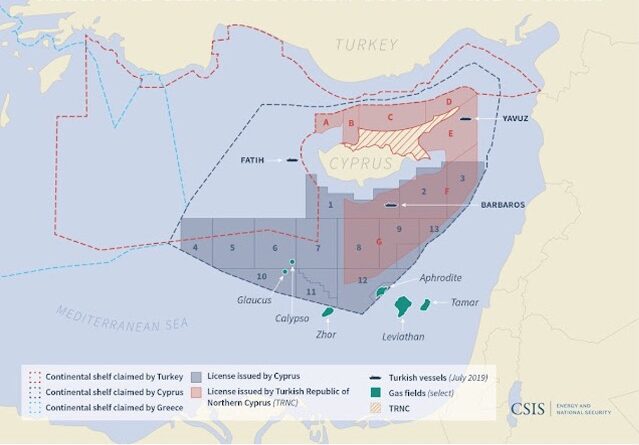
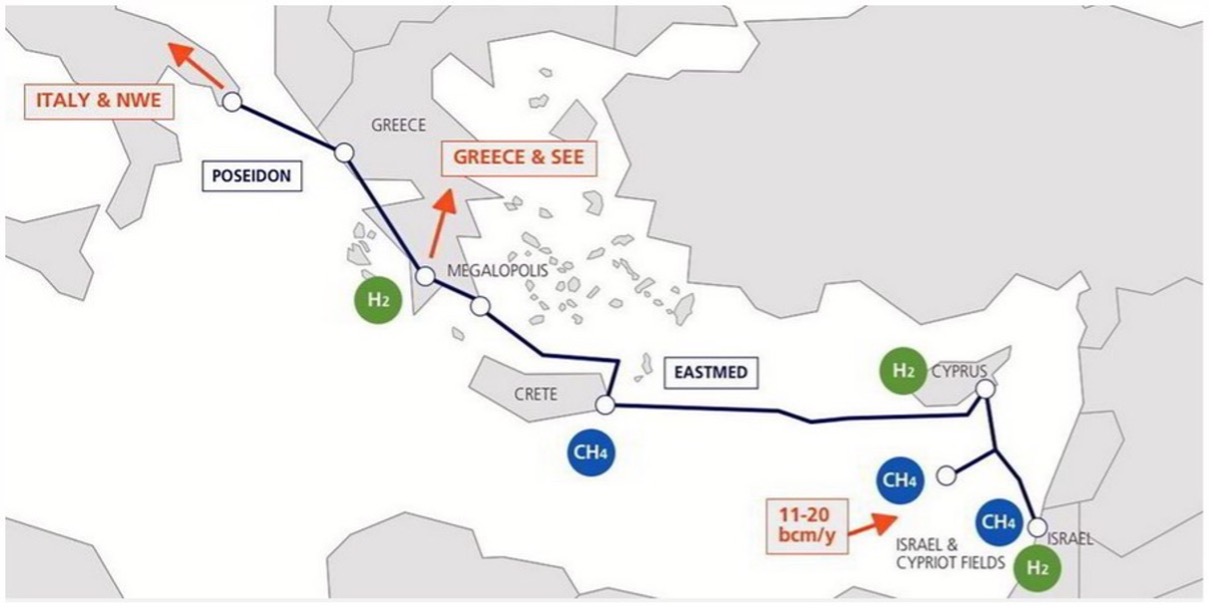
It must be noted that the Republic of Cyprus, having aligned itself with the Israel-Greece axis, has reaped significant benefits from this alliance. Although the Republic of Cyprus is recognized internationally, particularly by Western countries and is a member of the EU, the island’s division and Türkiye’s refusal to recognize it—despite Türkiye’s growing influence in the region—have enabled the Republic of Cyprus to expand its interests in various areas, particularly the energy sector, through the Israel-Greece axis. In this regard, it is believed that the project known as the Great Sea Interconnector (GSI)—which is planned to extend from Israel to the island of Cyprus and Greece and is projected to be the world’s longest undersea cable network—will enable the GKRY to break free from its energy isolation and integrate into the European energy market. Similarly, the EastMed pipeline project, which connects these three countries to transport natural gas from the Eastern Mediterranean to the European market, holds the promise of significant geopolitical and economic gains. However, the withdrawal of USA’s support for the project, Türkiye’s countermeasures and the project’s high cost are expected to lead to its shelving.
Türkiye against the Encirclement Strategy: Blue Homeland
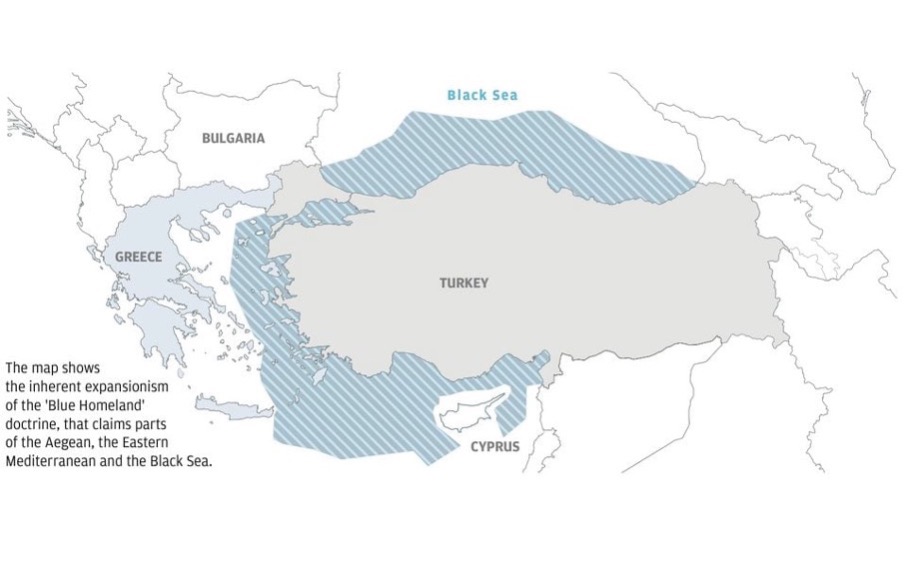
Türkiye has sought a path forward in the face of the EastMed project undertaken by Israel, Greece and the Greek Cypriot Administration, as well as an encirclement policy involving natural gas exploration and extraction activities in the region that could affect navigation in international waters. In this context, over the years it has been able to develop a comprehensive and long-term strategy against this axis, which is gaining strength in the Eastern Mediterranean. Türkiye has made a critical move to extricate itself from the grip of this axis—which has developed through Israel-Greece relations and includes the GKRY—by supporting the Government of National Accord established in Libya following the overthrow of the Gaddafi regime and by establishing bilateral relations with the new regime. In this context, the “Agreement on the Delimitation of Maritime Jurisdiction Areas in the Mediterranean,” signed between Türkiye and Libya on November 27, 2019, served as a significant step not only in strengthening bilateral relations but also in breaking this axis and ensuring Türkiye’s escape from being encircled in the Eastern Mediterranean. [1] On the other hand, following this agreement, as relations with the legitimate government in Libya continued to strengthen, the Tripoli government managed to hold its ground against attacks launched by Khalifa Haftar’s militias within the country, thanks to Türkiye’s substantial support.
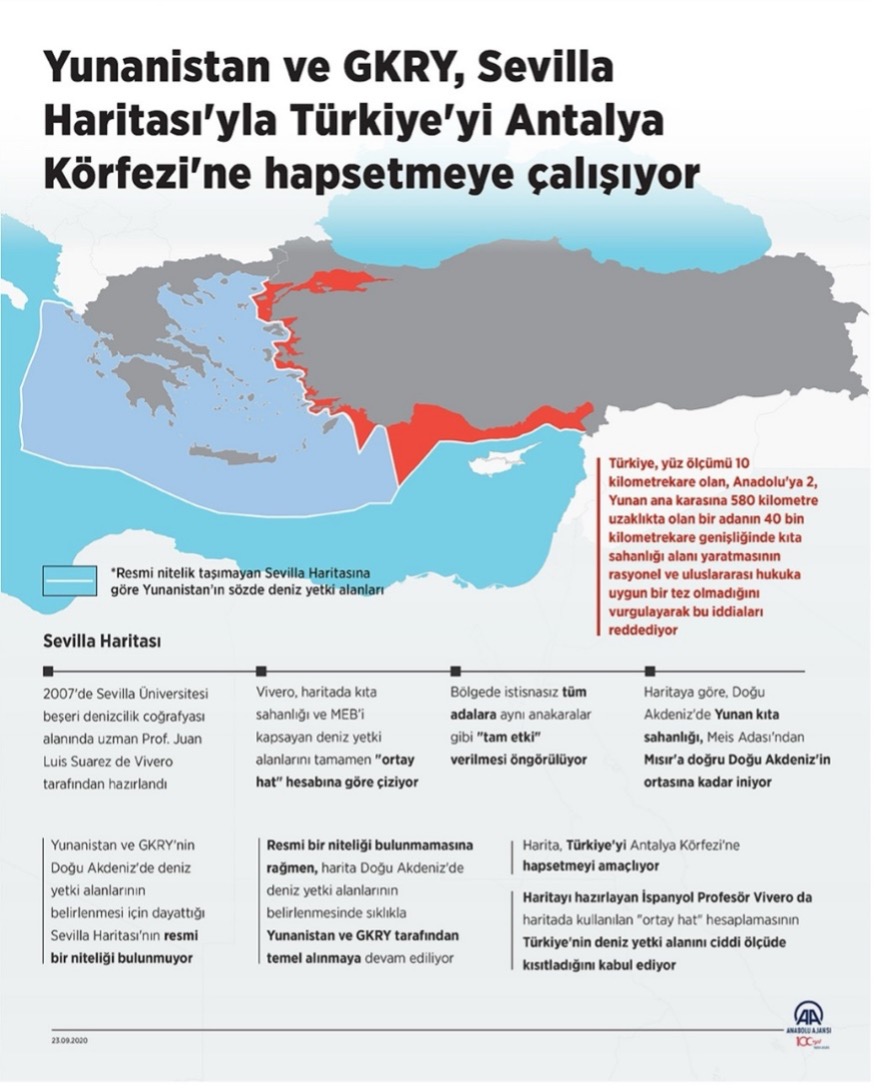
Essentially conceptualized under the “Blue Homeland” framework, this strategy aims to protect Türkiye’s interests within its territorial waters and beyond, particularly in the Eastern Mediterranean. It has been observed that Greece, which is seeking to expand its continental shelf in the Aegean Sea’s “Twelve Islands” region, has also embarked on an effort to encircle Türkiye in the Mediterranean. This project, known as the “Sevilla Map,” is based on the recognition of continental shelf rights for the Greek-controlled islands of Rhodes, Meis, Çoban and Kaşot off Türkiye’s southwestern coast. Fundamentally, the history of the Blue Homeland concept—which seeks to protect Türkiye’s rights regarding territorial waters and undersea resources in the three seas surrounding it—dates back further. However, it can be said that this term was officially adopted as state policy following the 2019 agreement between Türkiye and Libya regarding maritime jurisdiction areas.[2] In this context, Türkiye has been pursuing a policy since 2019 that is fully aware of the Israel-Greece axis developing against it in the region, both legally, diplomatically, and economically.
The TRNC, established in the northern part of the island of Cyprus following the struggle that ensued after the 1974 Operation, is another country situated directly opposite the Israel-Greece axis. Despite the TRNC’s approval of the Annan Plan and its efforts toward peace and reconciliation, the EU’s admission of the Greek Cypriot Administration as a member not only derailed political settlement initiatives on the island but also inflicted irreparable damage on Türkiye-EU relations. The TRNC, which has a special relationship with Türkiye and represents the Turkish identity on the island, shares geopolitical and geostrategic interests with Türkiye. For this reason, it is an undeniable fact that the TRNC’s security and interests in the Eastern Mediterranean are being encircled by the Israel-Greece axis. First and foremost, the TRNC—which is being excluded from the regional energy equation based on the Israel-Greece axis—is also facing security threats in many ways as the military dimension of this axis develops. In this context, the possibility of the “cold peace” established on the island years ago through Türkiye’s intervention being disrupted must be reconsidered. In particular, Israel—whose aggression is increasingly turning into a serious threat to regional countries—being an ally of Greece and the Greek Cypriot Administration heightens the risk of violations of TRNC territory, maritime and airspace. Of course, in this context, Türkiye’s special relationship with the TRNC and its stance against any threats to the country as a “guarantor state” continue to represent a significant advantage for the TRNC.
The Stance of Regional Actors on the Axis
Egypt, a major country in the region that resembles Türkiye in terms of military strength, population size and its location at a crossroads between continents, plays a critical role in its approach to the Israel-Greece axis. Having become a partner for the Israel-Greece axis following the discovery of energy resources in the Eastern Mediterranean, Egypt along with Israel, Greece and the Republic of Cyprus; spearheaded the establishment of the Cairo-based East Mediterranean Gas Forum (EGMF). The inclusion of France, Italy, Jordan and Palestine in this framework—which excludes Türkiye, Libya, Syria and Lebanon—appears contradictory from the perspective of the organization’s concept. On the other hand, the EGMF can be viewed as an institutional framework due to the planned implementation of the EastMed project which aims to transport natural gas from the Eastern Mediterranean to Europe. Following Türkiye’s agreement with Libya, the “Maritime Boundary Delimitation Agreement” signed between Egypt and Greece on August 6, 2020, serves as a response but also demonstrates the need for a consensus among countries regarding the resources in this region beyond the continental shelf. In this regard, it can be said that the restoration of diplomatic relations between Türkiye and Egypt has reached an inevitable point.
The relations between Türkiye and Egypt, which began in 2021 and have developed at the leadership level, are progressing toward deeper ties through the High-Level Strategic Cooperation Council and events such as EDEX 2025 and TransMea Expo. However, it would not be accurate to say that Egypt has completely distanced itself from or broken away from the Israel-Greece axis. Indeed, Egypt is currently engaged in cooperation mechanisms with these countries and most recently, signed a historic $35 billion natural gas agreement with Israel on December 17, 2025. While Egypt’s relations with Israel have strained during the genocide in Gaza, its efforts toward a ceasefire and humanitarian aid have brought it closer to Türkiye. In this regard, it appears that Egypt is not so much switching sides as it is striving to balance the power dynamics in the region within the framework of its own interests.
Within the framework of its rights in the Eastern Mediterranean, Palestine’s position vis-à-vis the Israel-Greece axis emerges as a critical yet neglected issue. Indeed, even the two-state solution approach grants Palestine rights in the Eastern Mediterranean through the 40-kilometer-long coastline of the Gaza Strip. However, Israel’s control over the waters off Gaza—in complete violation of UN resolutions—and its blockade, which has been in place since 2007, continue to this day. Israel, which has distanced Greece from the Palestinian issue through strategic cooperation, is also preventing the exploitation of the Gaza Marine field—located off the coast of Gaza, where 35 billion cubic meters of natural gas have been discovered. In this way, Israel is hindering economic development and preventing the improvement of the humanitarian situation by depriving the local population of access to marine resources in the Palestinian territories it has occupied on land and blockaded at sea. Israel also refuses to grant Palestine even its very limited coastal rights; it is evident that projects developed within the Israel-Greece axis completely disregard Palestine’s rights and consent.
Lebanon, one of the two countries located at the easternmost point of the Mediterranean, holds a critical strategic position due to its maritime borders with Israel, the Republic of Cyprus, the Turkish Republic of Northern Cyprus and Syria. While Lebanon was in the process of recovering from a long-standing civil war, it was once again plunged into turmoil by the assassination of Rafik Hariri and the 2006 war with Israel. Having experienced a major economic crisis in 2019, the country views the hydrocarbon resources discovered in the Eastern Mediterranean as a way out. Acting to balance its pro-Western political tradition and Iran’s influence, Lebanon signed a Maritime Boundary Delimitation Agreement with Israel in October 2022 under USA mediation. Under this agreement, the Qana gas field remains within Lebanese territory, while Israel was granted the right to produce in the Karish field.
While Lebanon, whose southern region was occupied by Israel in 2024 and where occupation and attacks continue in some areas, seeks to avoid conflict with regional powers for economic reasons, it is also striving to protect its sovereignty rights in its land, sea and airspace. In this regard, the country caught between necessity and resistance, appears to be attempting to fill the power vacuum created by Hezbollah’s significant loss of strength through diplomacy. The Maritime Boundary Delimitation Agreement signed by the Beirut government with the Republic of Cyprus in 2025 can also be viewed within this context. Indeed, objections have been raised in Lebanon claiming that, through this agreement the government revised a previous agreement and ceded a maritime area of between 2,500 and 5,000 km² to the Greek Cypriot Administration and that parliamentary approval was not obtained for this reason. Thus, while Lebanon has not objected to the activities of the Israel-Greece axis in the Eastern Mediterranean due to compelling reasons, it can be said that Lebanon is not far from Türkiye’s positions but acts in coordination with Western actors, particularly due to security and sovereignty concerns.
The overthrow of the Baath regime in Syria on December 8, 2024, has fundamentally shaken the balance of power in the Eastern Mediterranean, taking the strategic competition between the Israel-Greece axis and Türkiye to a new level. Given that Türkiye has been a key supporter and ally of the Damascus government during and after the revolution, it is fair to say that Türkiye has gained a significant ally in the Eastern Mediterranean in this regard. However, considering Israel’s occupation and violations in Syria, Türkiye is likely to find itself at odds with Israel not only over maritime areas but also because of its defense of Syria’s security and sovereignty. The Maritime Boundary Delimitation Agreement expected to be signed between Türkiye and Syria by 2026 is likely to serve as a measure to address the uncertainty in the Eastern Mediterranean and counter the Israel-Greece axis’s policy of encircling Türkiye. Another significant step Damascus could take in this regard might be the recognition of the TRNC. In light of these developments, it is foreseeable that the new Syrian administration could develop a policy in this direction; however, it is clear that Damascus has adopted a stance aligned with Türkiye regarding the Israel-Greece axis.
The Shifting Stance of Global Actors
While the Israel-Greece axis, supported by Western countries led by the USA, has received backing—particularly regarding energy policies—the EastMed project has not secured sufficient financial support from the USA Studies and analyses of the project have determined that EastMed’s cost amounts to as much as 6–7 billion euros. The project has not yet been implemented due to numerous factors, including its high cost, the need to extract gas from depths of approximately 2,000 meters in the region, its cost being 2.5 to 3 times higher than that of natural gas supplied by Russia and pressure from Türkiye. As noted, for these and other reasons, the Joe Biden administration which was in power in the USA from 2021 to 2025, sought to replace the GSI project with renewable energy by prioritizing it over fossil fuels. While the EU provided substantial support of 800 million euros for this 1.94 billion euro GSI project, it reportedly expressed concerns about the project’s security after receiving a warning that “the project cannot pass through waters under Türkiye’s control without Türkiye’s approval.”
Although neither project has been implemented so far, the political and diplomatic support from the USA and European countries for this axis appears to be continuing. However, in its latest document on the subject, the USA used the term “Eastern Mediterranean Energy Center” to describe developments within the Israel-Greece axis, stating that it views this as “the key to regional strategic stability and resilience.” It appears that the USA, aiming to integrate the GDI project into the India-Middle East-Europe Corridor (IMEC) project, is attempting to counter the influence of China’s Belt and Road Initiative (BRI) in this manner. While China is aware of this global initiative targeting its own project, it is pursuing a cautious balancing policy without jeopardizing its cooperation with regional actors, particularly Greece’s Port of Piraeus.
Russia, which continues to maintain its influence in Syria and the Eastern Mediterranean despite the revolution there, characterizes the EastMed and GSI projects as “uncertain and unprofitable” because they would reduce Europe’s energy dependence on Russia. From a military perspective, Russia views developments within the Israel-Greece axis as “an extension of NATO in the region” and is monitoring such developments accordingly. For these reasons, while Russia views the Eastern Mediterranean as an arena of competition with the USA and the EU in terms of both energy and security, it is simultaneously maintaining relations with regional countries to secure room for maneuver and focus on safeguarding its gains. Thus, it can be said that Russia, having adopted a strategy of competitive alignment is closely monitoring developments in the energy and security sectors in the Eastern Mediterranean and formulating its policies accordingly.
In Conclusion
The Israel-Greece axis, which has evolved from a strategic rapprochement between Israel and Greece into an effort to encircle Türkiye and disregard the TRNC through the unfair division of maritime resources in the Eastern Mediterranean is now facing the dead end of its unilateral policies. This bloc, which initially emerged as an energy and tourism partnership but gradually transformed into a Western-backed military alliance; has failed to materialize due to high-cost projects—such as EastMed—that adopt an exclusionary policy toward Türkiye, the USA withdrawal of support from the project, and, most importantly, Türkiye’s military and diplomatic deterrence on the ground. Furthermore, the outrage caused by Israel’s actions in Gaza—particularly within Greece’s domestic public opinion—has undermined the bloc’s legitimacy, while Türkiye’s multifaceted relationships with regional actors such as Egypt, Palestine, Lebanon and Syria have progressively narrowed this axis’s room for maneuver. Ultimately, despite Western support this containment policy driven by a coercive vision has lost ground in the face of Türkiye’s proactive balancing strategy (Blue Homeland, Libya Agreement etc.) and a new regional equation is emerging in which the parties will be forced to abandon this unjust division of power.
Beyond the rapprochement between the two countries in the Eastern Mediterranean, the Israel-Greece axis—which is based on encircling Türkiye and disregarding the TRNC through an unfair division of maritime resources—is gradually losing ground due to its unilateral and unjust approach despite receiving support from Western countries. Unable to implement its projects due to their financial and political costs, as well as Türkiye’s diplomatic maneuvers and the deterrent effect of its military power, the Israel-Greece axis is increasingly facing backlash in the region, particularly within Greece’s domestic public opinion, alongside the genocide in Gaza. In this process, it is quite possible that these allied countries—which have expanded their cooperation from the energy and tourism sectors into the military sphere—will be forced to abandon their unfair resource-sharing practices due to Türkiye’s strategy of strengthening its relations with Egypt, Palestine, Lebanon and Syria in the Eastern Mediterranean.
Footnotes
[1] Ayman Hayajneh and Khamis Al-Maslamani, “The Impact of the Maritime Border Demarcation Agreement between Turkey and Libya in the Mediterranean Sea (2019) on Turkish – Greek Relations (2017-2021),” Dirasat: Human and Social Sciences 51, no. 1 (2024): 404-419.
[2] Erdem Seçkin, “Doğu Akdeniz’deki Deniz Yetki Alanlarının Sınırlandırılması Sorunu ve Türkiye’nin Hak ve Menfaatlerinin Korunması,” (PhD. Thesis, Trakya University, 2021).
This article was first published on the Türkiye Research Foundation’s Website on March 17, 2026.