The collapse of the Assad regime on December 8, 2024, has ushered in a new political and social reality in Syria. Following nearly 14 years of civil war that began in 2011, Syria has evolved from a war-torn nation into one striving to construct a new political equilibrium. However, within this reconstruction process, there remains a flawed perception of Syria that overlooks the country’s inherent social dynamics and demographic structure. Syria is no longer governed by a minority; instead, a power structure shaped by sociological realities is now prevailing. Despite the tensions, conflicts, and manipulations observed in various regions since December 8, it is evident that the new administration, under the leadership of Ahmed al-Shara, is making intensive efforts to establish a stable and strong government. The developments over the past few months in regions with dense Druze populations, such as Suwayda and Jaramana, should be evaluated within this context. In this framework, the (Bedouin) Arabs moving in large numbers toward the Suwayda region—often in friction with the Druze—should be recognized as actors of the new order. In the “New Syria,” all groups must now accept this fundamental truth: it is no longer possible to create a permanent sphere of influence across the country by relying solely on external powers such as Israel, Iran, or the USA. Even under adverse scenarios, the sociological realities of the country will continue to reproduce themselves.
Demographics and Power
The Syrian landscape, a legacy of the Ottoman Empire, has historically been a region densely populated by Sunni Arabs. Sunni Arabs constitute approximately 65% of the Syrian population. The country also hosts a diverse array of ethnic and religious groups, including Turkmens, Alawites (Nusayris), Kurds, Shiites, Christians, Ismailis, and Druze. Despite this pluralistic sociological structure, the Assad family governed the country as a minority rule for 54 years, from 1970 until the revolution on December 8, 2024. The new era following the revolution has initiated a process in which the demographic majority has found the opportunity for political representation—perhaps for the first time since World War I.
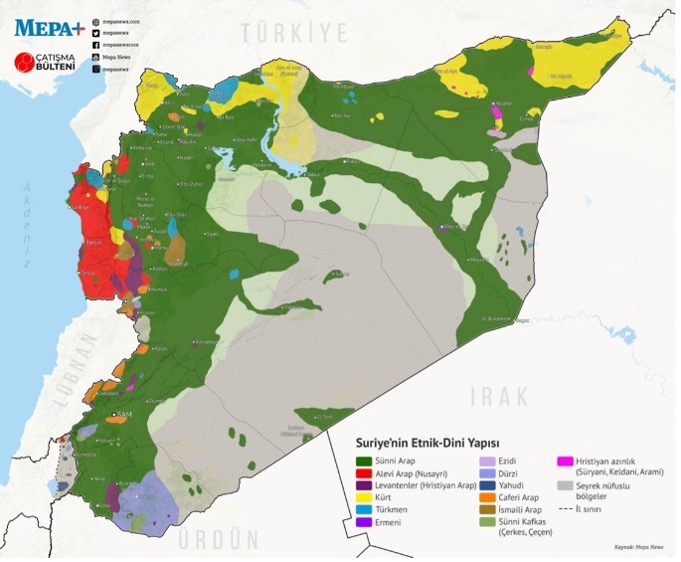
The termination of the 61-year Ba’athist rule in Syria has led to a profound reconfiguration of political power balances within the country. In this transitional process, the emergence of Sunni Arabs as a predominant force appears inevitable. Although the new administration, led by Ahmed al-Shara, seeks reconciliation with various ethnic and religious groups amidst the wreckage left by the Assad regime since 1970, it is evident that establishing absolute state authority remains a significant challenge. The persistent tensions and conflicts involving Alawites, Kurds, and Druze confirm this instability. Since the December 8 transition, several critical factors have defined this new era: massacres by the Shabiha (remnants of the Assad regime) in the north, the strategic activities of PKK-affiliated elements under the SDF umbrella in cooperation with the USA, and the frequent resort to violence by Druze factions led by Hikmet al-Hajjar, who opposes the new administration with Israeli support. In a broader sense, this situation can be interpreted as a resistance by certain minorities against the country’s fundamental sociological reality, bolstered by external support. Unfortunately, Syria continues to face severe obstacles in securing the monopoly on violence, which is the most essential prerequisite of a modern state.
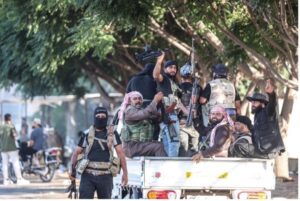
In the new power and actor structure, Sunni groups—who were systematically excluded by the Assad regime—are determined not to forfeit the political opportunities they have secured. The events unfolding in Suwayda are a direct reflection of this stance. The tension underlying the mass mobilization from various parts of the country toward Suwayda (specifically the march of Bedouin Arabs) and the subsequent clashes with Israeli-backed Druze groups stems precisely from this dynamic. Ultimately, the political actors of the new order are fighting to consolidate and protect their hard-won authority.
What Does Realpolitik Dictate?
In the context of the “New Syria,” Realpolitik offers several critical insights for the establishment of a functioning order. Firstly, all groups operating within the country must adapt to the political framework and actors that emerged after December 8. Failing to do so will make instability and conflict inevitable. Current social and political realities demonstrate that minority rule is no longer sustainable. Sociological dynamics necessitate a fundamental and permanent shift in Syria’s future governance. Secondly, seeking external backing or relying on foreign powers will not produce a durable political foundation. Efforts by demographic minorities to assert political dominance through foreign intervention will result only in further strife. In this regard, the statements by Tom Barrack, the USA Ambassador to Ankara and Special Envoy for Syria, concerning the Syrian Democratic Forces (SDF) are particularly striking. Barrack emphasized—without making a distinction between the SDF and the YPG—that the only viable solution is cooperation with the new Syrian administration. This is a crucial indicator that no regional actor can count on the unlimited support of the West or the USA. In other words, it does not appear possible for Kurdish elements to reach a position where they determine the national seat of power. The same reality applies to the Druze.
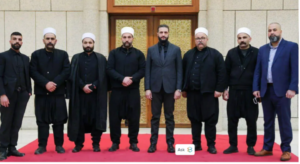
In contrast to the groups led by Hikmet al-Hajjar, the efforts of other Druze communities to align with the Damascus administration are noteworthy. Leading figures such as Sheikh Hamoud al-Hinnawi, Sheikh Yusuf Jarbou, and Leys Bulus have declared their support for the administration of Ahmed al-Shara. The inclusion of a Druze minister (the Minister of Agriculture) in the new government can be interpreted as a strategic signal of the regime’s commitment to inclusivity. Despite Israel’s support for al-Hajjar and its strikes targeting the Syrian administration, all actors wishing to maintain a presence in the new order must accept that the monopoly on the legitimate use of force resides with the Shara government. Failure to do so will mean that the clashes in Suwayda —and previously in Jaramana near Damascus— will continue to jeopardize national stability and security. In such a scenario, the ultimate loser would be the whole of Syria.
A Critical Choice for Minorities: Reconciliation or Conflict?
All minority groups, particularly the Druze, are at a crossroads requiring a strategic decision. An approach that ignores the country’s sociological realities and political balances while failing to account for regional dynamics will carry a heavy price. The Damascus administration must resort to all legitimate instruments of power to ensure the survival and integrity of its rule. The persistence of internal conflicts will only serve to deepen social animosities and strengthen pockets of resistance. Therefore, concrete steps must be taken to consolidate state authority by recognizing the leadership of Ahmed al-Shara. From a regional perspective, Israel’s expansionism and aggression, Iran’s shifting regional role, and the inconsistent policies of the USA are unlikely to bring stability; rather, they threaten to inflict new suffering upon the region. Under these prevailing conditions, Türkiye stands as the only realistic actor promising security and stability to the region.
Türkiye’s Position
For over a decade, Türkiye has remained the sole actor consistently promising stability and security in its periphery. Its policy regarding the new political order in Syria, its balanced engagement with local actors, and its development of multi-dimensional diplomacy mechanisms further reinforce this standing. Türkiye does not support any entity or formation that would undermine political stability in Syria or risk plunging the country back into chaos. Türkiye’s approach is rooted in a realist interpretation of Syria’s social and political fabric. It maintains that in the post-Assad era, the country’s genuine sociology must receive its rightful and proportional representation in the halls of governance.
This article was first published on the Türkiye Research Foundation’s Turkish website on July 19, 2025.