The fundamental assumptions of Europe’s external security architecture have been shattered by the Russia-Ukraine War, triggering a mandatory process of change and transformation. This architecture’s core military backbone is formed by NATO and, consequently, the USA’s nuclear power, while its political foundation rests on the principle that borders in Europe shall not be changed by force. At the continental level, it is upheld by national armies and the institutional mechanisms of the EU. Throughout the Cold War, the USA leadership was centralized against the Soviet threat; however, in the post-Cold War era, defense capacities were kept low due to the peaceful environment in Europe, economic priorities, and a relatively diminished perception of threat. Yet Russia’s revisionist interventions, the US tendency to limit its security commitments in Europe, and the war in Ukraine have rendered the restructuring of this architecture inevitable. Indeed, the accelerated increase in Germany’s defense budget since 2022, its initiatives to restructure energy dependency, and finally, the new military service law (Wehrdienstmodernisierungsgesetz) – which includes mandatory registration regulations effective January 1, 2026 are clear indicators of a radical shift in Berlin’s security paradigm.
German Security Architecture Prior to the Russia-Ukraine Crisis
Neorealism posits the international system as anarchic and views states as actors driven by the concern to maintain their security. This anarchic structure does not imply disorder or chaos; rather, it signifies the absence of a binding, centralized world government over states. Depending on the level of threat they encounter, states either pursue balancing by increasing their own capacities or exhibit buck-passing behavior by delegating security responsibilities to other actors.
Following the end of the Cold War, Germany relied heavily on NATO’s military capacity for its security for many years, thereby maintaining low defense expenditures. This approach can be characterized as a classic example of buck-passing, where Germany offloaded its security costs onto the USA.
The onset of a more aggressive Russian foreign policy starting in 2014, culminating in the invasion of Ukraine in 2022, fundamentally altered the security environment in Europe. In this context, the USA’s trend toward reducing its engagement in Europe increased the pressure on Germany, prompting a shift toward balancing strategies aimed at ensuring security through its own means. To accurately analyze this strategic transformation, a historical examination of the security architecture is essential.
The total disarmament of Germany after 1945, followed by its rapid rearmament due to the Soviet threat, demonstrates that the German security architecture has been shaped by external pressures. By joining NATO in 1955 and establishing the Bundeswehr, Germany became a central state under the NATO nuclear umbrella. The army reached a level of 480,000 – 500,000 personnel in the 1980s. Following the end of the Cold War, it was rapidly downsized. Post-unification, the number of troops was reduced to approximately 300.000 and in the 2000s, it was restructured to adapt to professionalization and external operations.
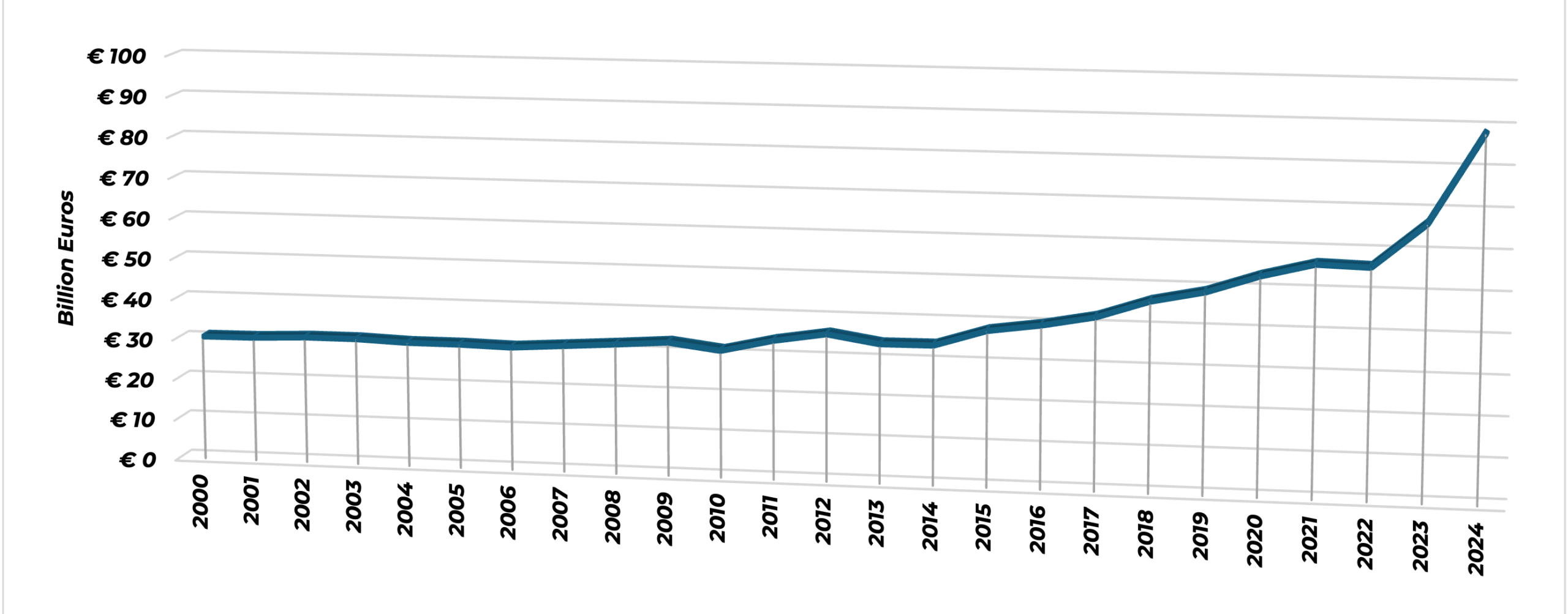
In 2011, conscription was abolished, personnel numbers dropped to 180.000 and the defense budget remained at only 1.1–1.2% of GDP (approximately 34 billion Euros). This was a continuation of buck-passing behavior during a period when the perception of threat was weak, and trust in the USA was high. According to German Ministry of Defense data, Germany had reduced its heavy armored elements. By 2015, only 30–40% of Leopard tanks were operational, and the readiness of the helicopter and Tornado fleets was at low levels. In a 2023 report, Defense Minister Pistorius told party members in parliament: “We do not have an army capable of defending the country against a military attack, a brutal war of aggression.”
While Russia’s annexation of Crimea in 2014 unsettled Germany, the transformation was slow. The 2016 and 2018 White Papers served as official strategy documents redefining security threats and signaling a hardening of defense policy. Although defense spending continued to rise steadily, structural modernization was lacking. Germany maintained the liberal assumption that economic interdependence would preserve peace with Russia—an assumption that was profoundly shaken in 2022.
Chart 1: Germany’s Defense Expenditures (Billion Euros)
Source: Figure prepared by the author based on data from SIPRI, NATO, and Global Security.
The Transformation of Germany’s Security Architecture
Russia’s invasion of Ukraine in February 2022 dismantled Germany’s assumptions one by one: the belief that Russia would not initiate a war, that the USA security guarantee via NATO would persist, that borders in Europe would not be changed by force, and that commercial relations with Russia would ensure a permanent peace. In an environment where Germany was 52% dependent on Russian gas, this dependency carried no deterrent value. While the USA provided support to Ukraine, it did not deploy NATO forces to the field, and as of 2025, it decided to reduce some of its units in Europe.
Chancellor Olaf Scholz, in a statement made three days after Russia’s invasion of Ukraine, defined this as a turning point (Zeitenwende) for Germany. A special fund of 100 billion Euros was established to accelerate the modernization of the military. This fund was specifically allocated for the procurement of weapon systems and the acquisition of F-35 aircraft. Additionally, Germany officially accepted the goal of increasing defense spending to 2% of its gross domestic product, responding positively to the burden-sharing long demanded by the U.S. within NATO. Decisions were made for the modernization of the military and forward deployment in Eastern Europe (the stationing of a permanent brigade in Lithuania). Merz and the defense minister personally attended the ceremony. These steps demonstrate that Germany is moving away from a buck-passing approach to its security and turning toward a more active balancing strategy.
Finally, the Federal Government reintroduced the registration system with the Wehrdienstmodernisierungsgesetz (Military Service Modernization Act), which will take effect in 2026. According to the law, all men born on or after January 1, 2008, will fill out a questionnaire for voluntary military service and undergo a medical examination. The current number of 182.000 soldiers in the Bundeswehr will be increased to 260.000 by 2035; there is also a target of 200.000 reserves. If targets are not met, selection will be made by lottery. From 2026, those serving six months will be provided with €2,600 monthly, and those serving 12 months or more will receive support for obtaining a driver’s license.
Social reactions indicate that this transformation requires a struggle for legitimacy within society; however, the factor determining the state’s security strategy is the pressure in the system, not the reaction of society.
The law also shows us the final point reached by defense spending, which has already been increasing rapidly and significantly since 2022. While the defense budget was at the level of 50.1 billion Euros in 2023, it is observed that the 2025 defense budget, with 24 billion Euros transferred from the special defense fund, has exceeded 86 billion Euros. This leap demonstrates that Germany’s defense spending, which grew quietly and without provocation during the 2014 – 2022 period, has transformed into a modernization process remarkably aimed at increasing capacity after 2022.
Despite the limitation in the USA commitment, Europe’s capacity building is accelerating. In this context, initiatives such as PESCO, carried out within the EU and aimed at defense cooperation among members, the EDF, which aims to finance defense projects, and the Strategic Compass, which determines the EU’s security priorities, are now fitting into a more meaningful framework and show that Europe is turning toward a more power-based defense architecture. Additionally, the spread of the Eastern European threat perception to the continent is changing Germany’s long-term role as the backbone of European defense.
Conclusion
In conclusion, Russia’s attack on Ukraine shook the old assumptions in Germany’s security architecture and pushed it toward a mandatory transformation. From a neorealist perspective, this transformation is a rational response to the shifting balance of power in favor of Russia and the weakening of current security guarantees. The rapid increase of the defense budget, the modernization of the military, and the reintroduction of mandatory registration are the fundamental elements of this process. The example of Germany demonstrates that the Russia-Ukraine crisis has accelerated a more capacity-oriented transformation in European security that will redefine the continent’s defense architecture.
This article was first published on Türkiye Research Foundation’s Turkish website on December 28, 2025.